Why Your Resume Gets Rejected and How to Fix It

You applied to 50+ jobs. You spent hours adjusting your resume. You waited. And yet, there is no response.
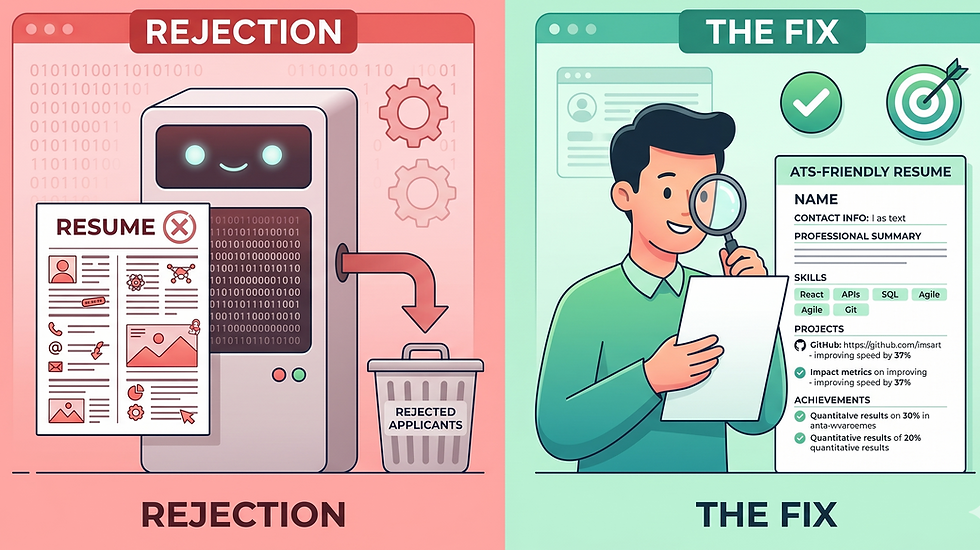
Before you blame hiring managers or the current job market, there is a hard truth you must accept: Your resume is likely getting rejected by an Applicant Tracking System (ATS) before a human even sees it.
Today, more than 90% of companies use ATS software to filter resumes. These systems do not care about your passion; they only care about two things: Keywords and Structure.
In this blog, we will break down why the ATS rejects your resume and how you can fix it step by step.

Mistake 1: Using Fancy Templates (Tables, Columns, Graphics)
The mistake: Many candidates use Canva or complex templates that feature decorations, icons, multi-column layouts, tables, and graphics.
Why it is a problem
Most ATS software cannot accurately read text inside shapes or images. Table-based formatting often scrambles the reading order of your text, and icons used for contact details (like a phone icon) can prevent the system from parsing your information.
How to fix it
Use a clean, single-column layout: This ensures the ATS reads your resume from top to bottom, left to right.
Stick to standard fonts: Use web-safe fonts like Roboto, Calibri, or Arial.
Export as a PDF: Unless the job description explicitly asks for a Word document, a flattened PDF is the safest bet for maintaining formatting.
Mistake 2: Ignoring Job Description Keywords
The mistake: Your resume describes what you want to say, rather than what the ATS is programmed to find. For example, if a job description mentions "React, APIs, CRUD, SQL, and Agile," but your resume simply says "Worked on web development projects," you have missed the mark.
Why it is a problem
The ATS is a matching engine. If the specific technical keywords from the job description are missing from your profile, you are automatically filtered out.
How to fix it
Identify Core Keywords: Highlight the technical skills and methodologies mentioned in the job post.
Integrate Naturally: Add these terms to your Skills section, Project descriptions, and Professional Summary.
The Master Resume Strategy: Maintain one master resume, but tailor the keywords specifically for every role you apply for.
Example rewrite:
Developed a Task Management App using React with CRUD operations, API integration, and Agile methodology.
Mistake 3: Writing Responsibilities, Not Achievements
The mistake: Writing passive statements like "Responsible for maintaining application data."
Why it is a problem
Every candidate was "responsible" for something. Recruiters and systems look for impact. Passive language does not help you stand out among hundreds of applicants.
How to fix it
Use the Action + Impact + Technology format.
Example rewrite:
Designed and implemented data workflows using OutSystems, improving processing speed by 37%.
Pro Tip: Replace “responsible for” with action words: Built, Developed, Improved, Automated, Delivered
Mistake 4: Lack of Proof of Work (No Projects / No Links)
The mistake: Your resume includes skills like:
“Java | OutSystems | SQL | APIs”
But there is no proof you can use them.
Why it’s a problem:
Skills without proof look like buzzwords. For developers, skills without proof are just words. For candidates without a traditional Computer Science degree, this is the number one reason for rejection.
How to fix it:
Add a Projects Section: Detail 2-3 significant projects.
Include Links: Provide clickable links to your GitHub, Portfolio, or live hosted applications.
Contextualize Skills: Instead of just listing "APIs," write: "Built an Expense Tracker App using OutSystems with CRUD operations and API integration for authentication."
Example rewrite:
Project: Expense Tracker App Built using OutSystems with CRUD operations and API integration for authentication.
Pro Tip: Projects TRUMP degrees. Especially for non-CS candidates.
Mistake 5: Poor Resume Structure and Formatting
The mistake: Placing sections in a random or unconventional order, such as putting Education at the very top when you have relevant work experience.
Why it is a problem
ATS algorithms expect a specific logical flow to extract data correctly. Unusual structures lead to "parsing errors" where your experience might end up in the education field.
The Correct ATS-Friendly Structure
Header: Name and Professional Contact Information.
Professional Summary: A 3-line pitch of your expertise.
Skills and Tools: A categorized list of technologies.
Projects: High-impact technical work.
Experience: Work history or Internships in reverse-chronological order.
Education: Degrees and relevant academic background.
Certifications: Professional courses and credentials.
Pro Tip: Personal details like marital status, DOB= unnecessary & harmful.
Final Thoughts
Your resume is your first interview. It is a marketing document designed to sell your skills to a machine first and a human second. If you use a clean structure, match your keywords to the job description, and focus on measurable achievements, you will significantly increase your chances of getting that interview call even without a Computer Science degree.


Comments